Capacity types (window)
Last updated: 26 August 2025
 Settings > Capacity types
In this article
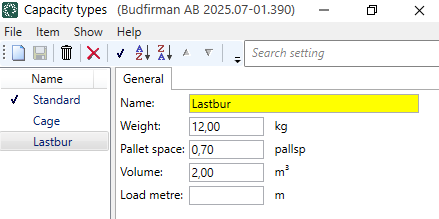
In this window you add load types (capacities) which are then displayed in the Vehicle and Vehicle Type registers. For example, "cargo cage" may be a cargo type that you may want to add here.
In the registers for vehicles and vehicle types, you then enter the maximum number of loads that the vehicle or vehicle type can carry. For example, they may be load cages and the vehicle/vehicle type may have a maximum of 8 load cages. See the tab Capacity and the box Capacity in the registers for vehicles and vehicle types. For more information, see Vehicles (window) and Vehicle types (window).
Proceed as follows
Add a new load type by clicking on  , give the load type a name and then enter the weight, Pallet space, volume and/or load metre for the load type. Click on Save to save all changes.
General
|
Function |
Description |
|---|---|
|
Name |
Give the load type a name, for example "Load cage". |
|
Weight |
Enter the weight of the load type. Weight is given in kilograms (kg). |
|
Pallet space |
Enter the number of Pallet spaces that the load type corresponds to, for example "0.4". |
|
Volume |
Enter the volume of the load type, i.e. indicate how much volume the load carrier occupies in the vehicle. Volume is expressed in cubic metres (m3). |
|
Load metre |
Indicate how many load metres the load type occupies in the vehicle. Load metres are given in metres (m). |

