Step price and benefit/worst price calculation
Last updated: 18 September 2025
In this article
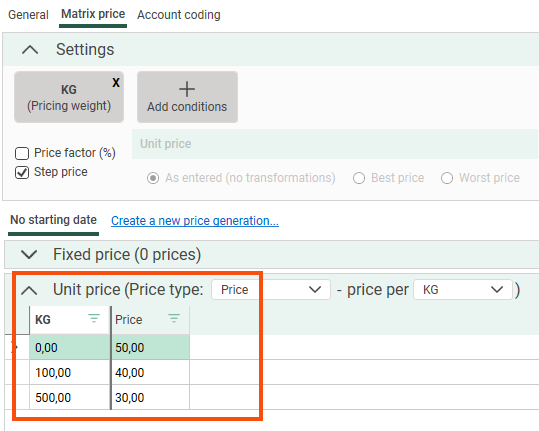
You can work with different unit prices for different ranges in the same price matrix. For example:
-
From 0 kg: 50 kr/kg.
-
From 100 kg: 40 kr/kg.
Prices are then handled differently depending on the settings in the price matrix. You can choose whether to calculate the prices separately for each range and add up the subtotals (tick Step price), or calculate the price straight, the number of units × the price for that range (tick one of the options under Unit price).
Tiered pricing can be used for both fixed prices and unit prices, but it cannot be combined with advantage or Worst price calculations.
When using tiered pricing, the values you enter in the matrix (100 and 500 in the image below) are not from prices. For exactly those values, the price from the previous interval is used when calculating the price.
In this example, 100 kg gives the price 100 × 50 = 5 000 SEK, not (99 × 50) + (1 × 40) = 4 990 SEK. 101 kg gives the price (100 × 50) + (1 × 40) = SEK 5 040.
On the other hand, if you deselect Step price, 100 kg gives 100 × 40 = 4 000 SEK(not 100 × 50).
A further example can be found in Examples of pricing.
Example
The examples show how the settings affect the price calculation for an order with a weight of 90kg and an order with a weight of 110kg and the above prices.
|
Setting and weight of the order |
Price calculation |
Remark |
|---|---|---|
|
Step price, 90 kg |
90 kg × 50 kr/kg = 4 500 kr |
The price per kg is calculated separately for each range in the matrix, but in this example the weight is within one range. |
|
As entered (no transformations), 90 kg |
90 kg × 50 kr/kg = 4 500 kr |
The price per kg will be the one for that weight range in the whole weight matrix. |
|
Best price, 90 kg |
100 kg × 40 kr/kg = 4 000 kr |
Calculates the most favourable price for the customer. A higher weight than the real one is used in the calculation because the real weight gives a higher price, 90 × 50 = 4 500 SEK. |
|
Worst price, 90 kg |
90 kg × 50 kr/kg = 4 500 kr |
Calculates the most favourable price for you, i.e. to the detriment of the customer. In this example, it is the same as a straight calculation. |
|
Step price, 110 kg |
100 kg × 50 kr/kg = 5 000 plus 10 kg × 40 kr/kg = 400 Total SEK 5 400 |
The unit price is calculated separately for each interval in the matrix. The weight is spread over two intervals and the subtotals are totalled. |
|
As entered (no transformations), 110 kg |
110 kg × 40 kr/kg = 4 400 kr |
The price per kg will be the one for that weight range in the whole weight matrix. |
|
Best price, 110 kg |
110 kg × 40 kr/kg = 4 400 kr |
Calculates the most favourable price for the customer. In this example, it is the same as a straight calculation. |
|
Worst price, 110 kg |
100 kg × 50 kr/kg = 5 000 kr |
Calculates the most favourable price for you, i.e. to the detriment of the customer. A lower weight than the real one is used in the calculation because the real weight gives a lower price, 110 × 40 = 4 400 SEK. |
A further example can be found in Examples of pricing.

