Setting up weight calculation for long goods
Last updated: 21 July 2026
In this article
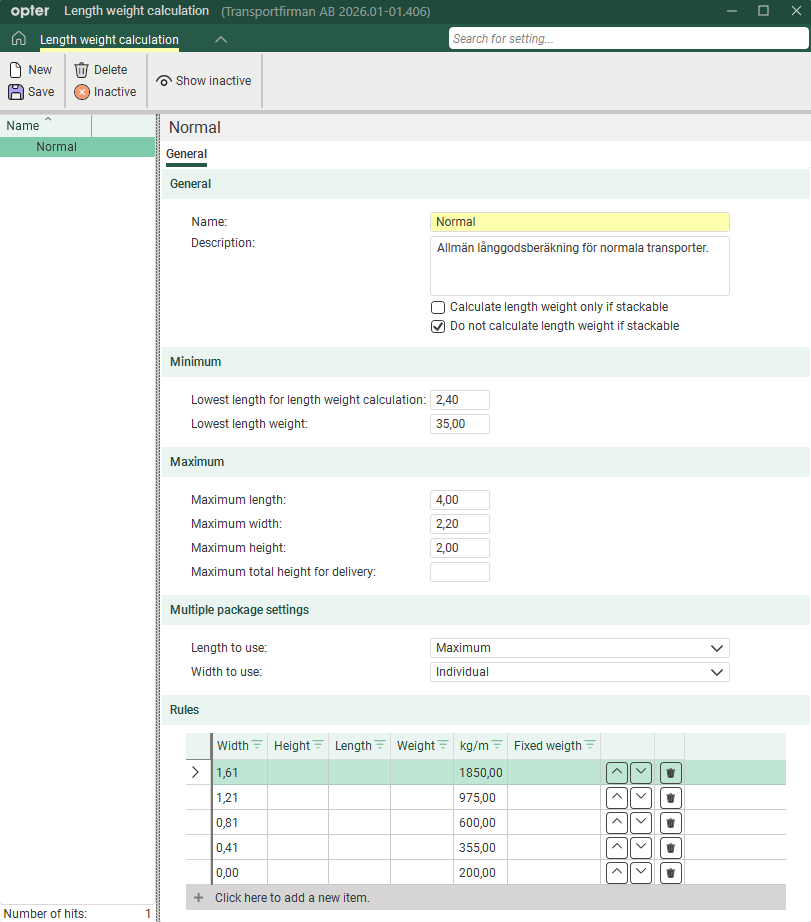
If you are using dimension Length weight length and want it to be convertible into a pricing weight, you must set up rules for weight calculations for long goods. You can configure these settings in the window Length weight calculation. There, you also define what is to be regarded as long goods by specifying the minimum and maximum dimensions for the packages that are to be assigned a length weight.
The fields in the window are described in Length weight calculation (window). The method for calculating the pricing weight is described in Calculating the pricing weight.
Create a length weight calculation
Here’s how to define which parcels are to be classified as long goods and how the weight of long goods is calculated.
-
Click on Settings > Weight calculation. Select the weight calculation you want to work with in the list on the left.
-
From the drop-down menu Length weight calculation (on the General tab), go to

The Length weight calculation window opens.
-
Click on New to create a new length weight calculation. Give the length weight calculation a name and possibly a description.
-
In the following fields, specify the dimensions that must be met for a parcel to be classified as long goods:
-
Lowest length for length weight calculation, for example 2.40 metres.
-
Maximum length (metres).
-
Maximum width (metres).
-
Maximum height (metres).
The fields Lowest length for length weight calculation and Maximum length therefore define a range for the length of the long goods.
-
-
In the Lowest length weight field, enter the minimum length weight that the calculation can return, for example 35 kg.
This means that if the length weight calculation results in a length weight of 22 kg (i.e. less than 35 kg), Opter will use 35 kg instead.
-
In Length to use and Width to use, you select the length and width to be used if the order contains more than one parcel:
-
Maximum: The dimensions of the longest/widest parcel are used for all parcels that meet the definition of long goods.
If the longest or widest parcel exceeds the maximum dimensions, no length weight calculation is carried out.
-
Sum from all packages: The length and width of all packages are added together, and the total must fall within the minimum and maximum dimensions for a length weight calculation to be carried out.
-
Individual: The length weight is calculated separately for each package and then totalled to give the total length weight length for the order.
Example: You have an order in which the longest parcel is 3.50 metres long and you set Maximum to Length to use. If the length range is 2.40–4 metres and the maximum width is 2 metres, the length weight calculation is carried out for all parcels that are between 2.40 and 3.50 metres in length (as this was the longest parcel) and no more than 2 metres wide. A length of 3.50 is used for all parcels in the calculation, regardless of their actual length. If you have a parcel that is 2.3 metres wide, the length weight calculation is not applied to that parcel at all, as it is wider than the maximum width.
If, instead, you set Maximum for Width to use, no length weight calculation is carried out at all, as the widest package is wider than the maximum width.
-
-
In the table below Rules, specify the rules that are to apply to the length weight calculation. Enter one line per row.
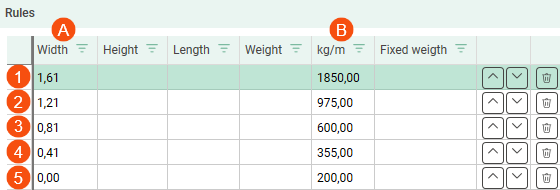
In the first four columns (Width, Height, Length and Weight) you indicate which conditions apply. On each line, you can enter one or more terms, for example Width and Height, or just Width.
In the next two columns (kg/m and Fixed weigth), specify the result you want:
-
(kg/m) means that the weight you enter in the table is multiplied by the length of the package.
-
Fixed weigth means that a consignment which meets the definition of long goods will be assigned the length weight that you enter in the table.
Opter checks the rules from top to bottom of the table, so it is important that you put the rules in the right order. You can move the rows up and down using the buttons

 .
.
This is how Opter uses the table:
-
Opter first checks whether the criteria in the fields above the table are met. That the length, width and height of the load are within the limits for long loads.
-
Opter then checks the rule on the first line (1).
If the package is 1.61 metres wide or more, Opter uses the factor for that row (B), 1,850 kg/m, when calculating the length weight. If the length of the consignment is 3.5 m, the length weight will be 6,475 kg (3.5 × 1,850 = 6,475).
-
If the package is not as wide as 1.61 metres, Opter moves on to the next line (2) and checks whether the width is between 1.21 and 1.60 metres. In that case, the length weight will be 3.5 × 975 = 3,412.50 kg.
-
If the package is between 0.81 and 1.2 metres wide, use row 3, and so on.
-
-
Click on Save to save all changes.
Testing
We recommend that you check that the result of the length weight calculation – and therefore also the pricing weight calculation – is as you require.
Create a new order in the order reception system and test it using different lengths and widths for a parcel. Will the pricing weighting be as you wish?
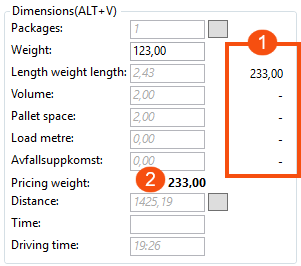
Under Dimensions, you can see the results of the weight calculation for the various dimensions (1), and the pricing weight used for the order (2). Opter uses the largest weight from the dimensions as the pricing weight. In this example, the length weight is used as the weight for pricing purposes.
Try including more than one parcel in the order. Make the columns different lengths and widths. Will the pricing weighting be as you wish?
Example
Two parcels of different widths
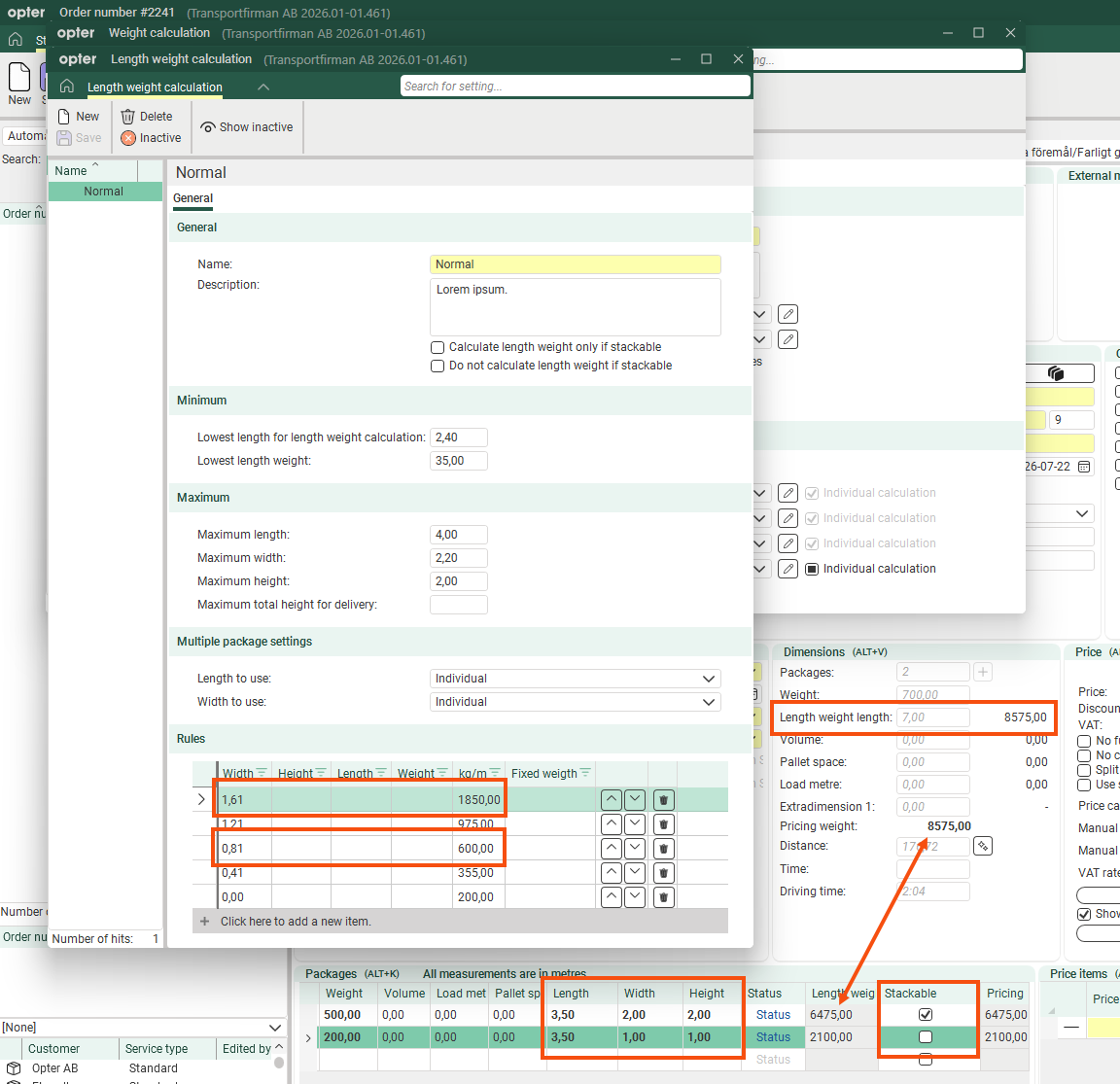
In this example, we have two parcels that are classified as long goods. They have different widths and therefore have different length weights according to the length weight calculation.
-
3.5 × 1,850 = 6,475
-
3.5 × 600 = 2,100
The total pricing weight is 8,575. One of the collines is marked as stackable, but as none of those settings are enabled, it makes no difference.
Stackable goods
If you are transporting flagpoles, you can make the most of the space by stacking several flagpoles on top of one another or placing them on top of other goods. Flagpoles are durable and not too heavy. Consequently, the length weight – and therefore the price – may be lower than if the flagpoles had taken up the entire width of the vehicle.
In that case, you should classify the flagpoles as long goods. Create a length weight calculation, for example ‘Flagpole’, with dimensions and weight corresponding to such packages. None of the boxes need to be ticked, as the consignment is regarded as long goods provided it meets the dimensions.
If you flag other goods with the same dimensions as ‘stackable’ in the order reception system to indicate that goods can be placed on top of them (for example, flagpoles), tick the box Do not calculate length weight if stackable. In this case, goods occupying the area not are counted as long goods, but the flagpoles (which not are stackable) are regarded as long goods.
Troubleshooting
If the pricing weight is not as you wish, you can check the following:
-
Under Dimensions in the order reception, you can see the results of the weight calculation for the various dimensions (1), and which pricing weight is applied to the order (2). Opter uses the largest weight from the dimensions as the pricing weight. Check the weight calculation settings. For more information, see Calculating the pricing weight.
-
If you have several different length weight calculations, check that the correct one is selected in the drop-down list Length weight calculation in window Weight calculation (the tab General)
Also check which weight calculation is used by default. The standard calculation is marked with
 . There may also be exceptions for a particular price list or customer. For more information, see Calculating the pricing weight.
 -
Check that the settings for dimensions Load metre, Volume and Pallet space are set as required on the Automatic dimensions tab of the weight calculation. For more information, see Weight calculation (window).
-
If the pricing weight is rounded incorrectly, check the settings in window Rounding rules. For more information, see Rounding rules (window) and Calculating the pricing weight.

