Setting up weight calculation for long goods
Last updated: 24 September 2025
In this article
If you use the dimension Pikkus kaalu pikkus, and if you want Pikkus kaalu pikkus to be converted to pricing weight, you need to set the rules that Opter will follow for weight calculations for long goods. You make these settings in the window Pikkuse kaalu arvutamine. The fields in the window are described in Pikkuse kaalu arvutamine (window). How pricing weights are calculated is described in Calculating the pricing weight.
Proceed as follows
To set the rules that Opter will follow for weight calculations for long goods, do the following
-
Click on Seaded > Kaalu arvutamine. Select the weight calculation you want to work with in the list on the left.
-
From the drop-down menu Pikkuse kaalu arvutamine (on the Üldine tab), go to

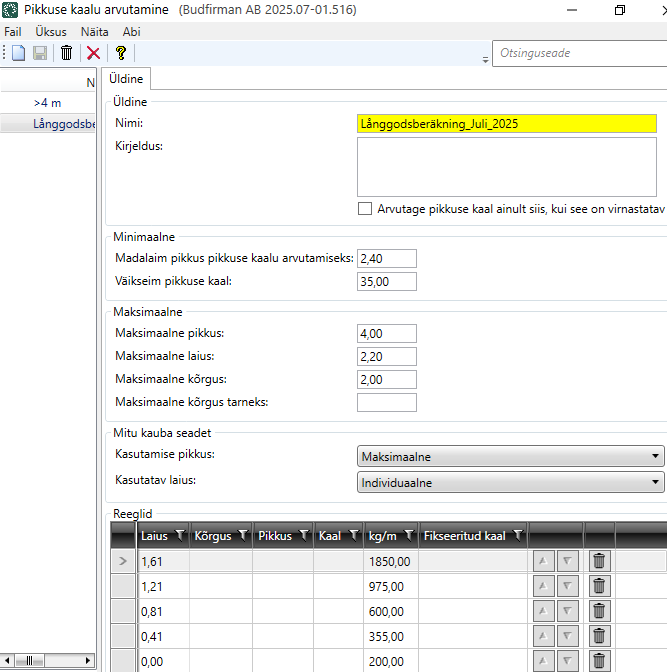
The Pikkuse kaalu arvutamine window opens. The fields in the window are described in Pikkuse kaalu arvutamine (window).
-
Click on Uus to create a new length weight calculation. Give the length weight calculation a name and possibly a description.
-
If you want goods to be considered as long goods only if they are stackable, tick the checkbox Arvutage pikkuse kaal ainult siis, kui see on virnastatav. For more information, see Pikkuse kaalu arvutamine (window).
-
In the Väikseim pikkuse kaal field, enter the minimum length weight that this calculation can return, for example 35kg.
This means that if the total of the long-haul weight calculation is 22 kg (i.e. less than 35 kg), Opter will use 35 kg as the result of the long-haul weight calculation.
-
In the following fields, enter the maximum and minimum length, as well as the maximum width and height of the package in order for the long fold calculation to be performed.
-
Madalaim pikkus pikkuse kaalu arvutamiseks, for example 2.40 metres.
-
Maksimaalne pikkus.
-
Maksimaalne laius.
-
Maksimaalne kõrgus.
-
-
In the Maksimaalne kõrgus tarneks field, enter the maximum total height of the order for the long goods weight calculation to be performed.
-
In the following drop-down lists, specify the length and width to be used in the long goods weight calculation, if the order contains more than one parcel:
-
Kasutamise pikkus.
For example, if you want the length of the longest collar to be used in the calculation, select Maksimaalne.
-
Kasutatav laius.
For example, if you want the width of each individual parcel to be used in the calculation, select Individuaalne.
The length weight is then calculated separately for each package, then these separate length weights are totalled.
-
-
In the table (in the box Reeglid), enter the rules that will apply to the long goods weight calculation. Enter one line per row.
In the first four columns (Laius, Kõrgus, Pikkus and Kaal) you indicate which conditions apply. On each line, you can enter one or more terms, for example Laius and Kõrgus, or just Laius.
In the next two columns (kg/m and Fikseeritud kaal), enter the result you want. Choose whether you want to use a fixed length weight (Fikseeritud kaal) for a row, or whether you want to use a factor (kg/m) to multiply the number of metres by.
Opter checks the rules from top to bottom of the table, so it is important that you put the rules in the right order. You can use the arrow buttons
 to move a line up or down, so that you get the rules in the order you want.
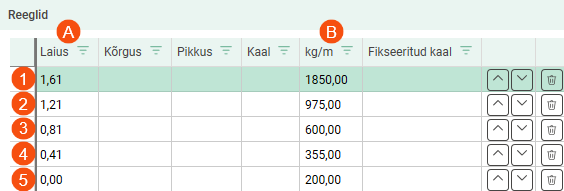
For example, the table might look like this: (The picture shows Opter in a new design.)
This is how Opter uses the table:
-
Opter first checks whether the criteria in the fields above the table are met. For example, whether the criteria for maximum and minimum length, as well as maximum width and height of the package are met in order for the long freight calculation to be performed.
-
Opter checks the rule on the top row (1 in the image above).
If the width (A) is 1.61 metres or more, Opter uses the factor (B) 1850 kg/m for the weight calculation.
For example, if the width is 2 m, Opter uses the factor 1850 kg/m. The calculation is then 2 x 1850 = 3700 kg.
-
If the width is not 1.61 metres or more, Opter moves on to the row under (2) and checks if the width is 1.21 metres or more, in which case Opter uses the factor 975 kg/m. For example, if the width is 1.40 metres, the calculation is 1.40 x 975 = 1365 kg.
Row 2 is therefore used if the width is between 1.21 and 1.60 metres.
Row 3 is used if the width is between 0.81 and 1.20 metres, and so on.
-
-
Click on Salvesta to save all changes.
Testing
We recommend that you test that the result of the long goods weight calculation and thus also the calculation of the pricing weight is as you wish. Proceed as follows:
-
Create a new order in Order reception and test with, for example, different lengths and widths of packages. Will the pricing weighting be as you wish?
In the Mõõtmed box in Order reception, you will see the results of the weight calculation for the different dimensions (1 in the image below), and the pricing weight Opter will apply to the order (2). (Opter uses the largest corresponding weight from the dimensions as the pricing weight).
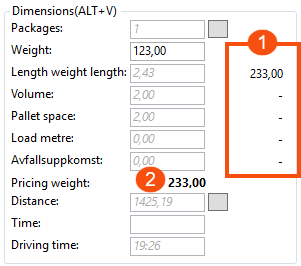
In the image, Opter uses the long goods weight calculation as the pricing weight of the order.
-
Feel free to test with more than one parcel on the order. For example, GIF packages of different widths. Will the pricing weighting be as you wish?
Troubleshooting
If the pricing weight is not as you wish, you can check the following:
-
In the Mõõtmed box in the Order reception, you will see the weight calculation results for the different dimensions (1 in the image above), and the pricing weight Opter will apply to the order (2). Opter uses the greatest corresponding weight from the dimensions as the pricing weight. You may need to change some weight calculation settings to get the pricing weight you want. See the "Do this" section of Calculating the pricing weight.
-
In the Kaalu arvutamine window on the Üldine tab, check that the correct length weight calculation is selected in the Pikkuse kaalu arvutamine drop-down list (if you have several different ones).
You can also check that the correct weight calculation is generally used in your Opter, by looking in the list on the left which one is marked as default
 . There may also be exceptions for a particular price list or customer, for more information see Calculating the pricing weight.
 -
In the Kaalu arvutamine window on the Automaatsed mõõdud tab, check that the settings for the dimensions LDM, Maht and Kaubaaluste koht are set as you wish. For more information, see Kaalu arvutamine (window).
-
If the pricing weight is rounded incorrectly, check the settings in the Ümardamise reeglid. For more information, see Ümardamise reeglid (window) and Calculating the pricing weight window.

